

Rents are continuing to rise across Australia, but for investors, the bigger question is where demand is strongest and whether the numbers still make sense.
Australia’s rental market remains under pressure.
Across many parts of the country, renters are facing higher weekly costs while available properties remain limited. At the same time, investors are watching rental growth closely and asking whether today’s conditions create an opportunity.
The answer is not as simple as looking at rising rents.
For property investors, rental income is only one part of the equation. The location, purchase price, vacancy risk, property type, future supply and long term growth potential all matter.
And in today’s market, knowing where to look can be just as important as knowing when to buy.
Australia’s rental market remains tight
The latest Cotality Rental Review shows that national dwelling rents increased by 5.9% over the year to June 2026, bringing the median national rent to $705 per week.
Over the past five years, national rents have increased by 40.6%, adding around $204 per week to the typical rental commitment.
At the same time, the national dwelling vacancy rate remained low at 1.6%, while rental listings were 16.7% below their five year average.
This tells us something important.
The pressure on rents is not simply about landlords increasing prices. There is a broader imbalance between the number of people looking for housing and the amount of available rental stock.
Rising rents are not the same everywhere
Australia does not have one single rental market.
Conditions can vary significantly between cities and even between neighbouring suburbs.
In June 2026, Sydney remained the most expensive capital city rental market, with a median dwelling rent of $841 per week.
But Perth and Brisbane are moving closer, with median rents of $784 and $734 per week respectively.
Adelaide’s median dwelling rent was $662 per week, while Melbourne remained more affordable at $641.
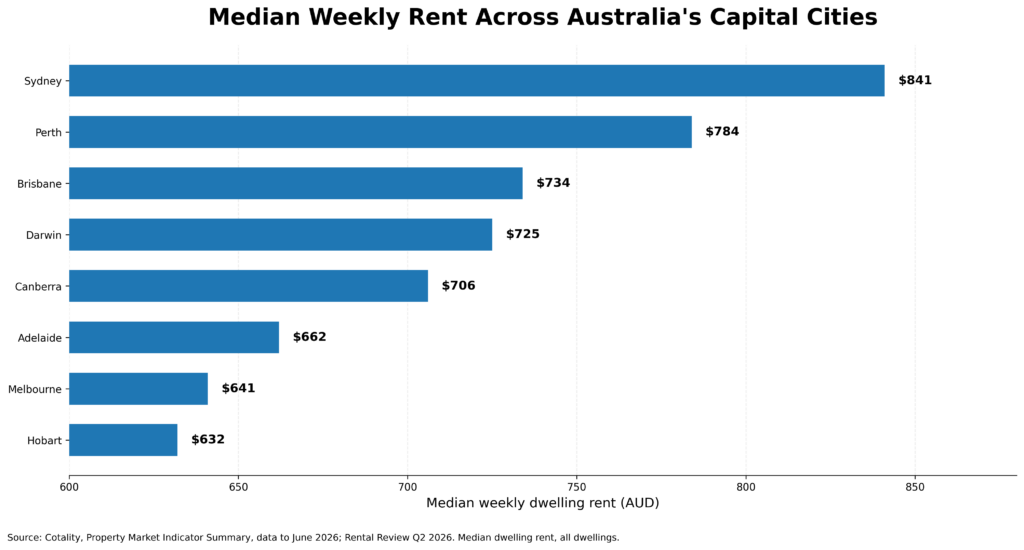
The difference between cities is important for investors.
A higher rent does not automatically make a property a better investment. Sydney, for example, has the highest median rent, but investors also need to consider the higher cost of purchasing property there.
This is why looking at rental income on its own can give an incomplete picture
Why are rents continuing to rise?
There are several factors contributing to the current rental environment.
Limited rental supply
There are simply not enough available rental properties in many areas.
Cotality’s June data shows that rental listings remained well below their five year average, while every capital city recorded a vacancy rate below 2%. Adelaide was particularly tight, with a vacancy rate of just 1.0%.
Population growth and housing demand
As Australia’s population grows, more people need somewhere to live.
When housing construction and available rental stock do not keep pace with demand, competition for existing properties can increase.
Affordability pressures
Higher rents are also creating affordability challenges for tenants.
Cotality estimates that the typical Australian household was allocating roughly one third of gross income to rent in March 2026, compared with around 27% five years earlier.
This is important for investors too.
Rental growth cannot continue indefinitely if tenants are reaching the limits of what they can afford.
What does this mean for property investors?
For investors, strong rental demand can be encouraging.
A property in an area with limited rental supply and consistent tenant demand may offer better conditions for rental income and lower vacancy risk.
But this does not mean investors should simply chase the highest rental yield.
A property with a high yield may have limited long term growth potential.
Another property may offer a lower initial yield but be located in an area with stronger population growth, better infrastructure, limited future supply and greater potential for capital growth.
The right choice depends on the investor’s broader strategy.

Look beyond the headline rental yield
Before buying an investment property, it is worth considering the full picture.
Some of the questions investors should ask include:
Is rental demand likely to remain strong?
A suburb with a shortage of rental properties today may not have the same conditions in five or ten years.
What is happening with new housing supply?
Large numbers of new properties coming into the market could change rental competition over time.
Is the purchase price reasonable?
A strong rental return can lose some of its appeal if an investor pays too much for the property.
What is happening in the local area?
Population growth, employment, infrastructure, schools, transport and amenities can all influence long term demand.
Does the property fit the investor’s goals?
The right property for one investor may not be the right property for another.
Why location matters more in this market
National statistics can tell us what is happening across Australia, but property decisions are ultimately local.
Two suburbs in the same city can have completely different rental markets.
One may have strong tenant demand, limited supply and improving infrastructure.
Another may have a large pipeline of new apartments, higher vacancy risk and weaker long term demand.
This is why investors need to look beyond the headline numbers.
The question is not simply:
“Where are rents rising?”
A better question is:
“Where are rental demand, supply, affordability and long term property fundamentals working together?”
Where a buyer’s agent can help
This is where having the right guidance can make the buying process easier.
A buyer’s agent can help investors research locations, compare properties, understand local market conditions and assess whether a property makes sense within their broader investment strategy.
They can also help buyers understand what they are actually paying for a property and negotiate on their behalf.
In a market where quality properties can attract competition, having someone focused on the buyer’s interests can help reduce the risk of making an emotional decision.
The role is not simply to find a property.
It is about helping the buyer determine whether the property is the right fit before committing to the purchase.

What should investors watch from here?
Rising rents are likely to remain an important part of Australia’s property story, but investors should watch more than just weekly rental prices.
Keep an eye on:
- Rental vacancy rates
- New rental listings
- Population growth
- New housing construction
- Local infrastructure
- Rental affordability
- Property prices
- Gross and net rental yields
- Long term capital growth potential
These factors can help paint a much clearer picture of whether a location is likely to remain attractive to tenants and investors.
Final thoughts
Australia’s rental market remains tight, and rising rents are creating both challenges and opportunities.
For investors, however, this is not simply a story about collecting higher rent.
It is about understanding why rents are rising, where demand is strongest, how much new supply is coming, and whether the property still represents good value at today’s price.
The strongest investment decisions are rarely based on one number.
They come from looking at the whole picture and having a strategy that can work beyond today’s market conditions.
References
Cotality, Rental Review Q2 2026:
Rental growth accelerates annually as Perth and Brisbane close the gap to Sydney
Cotality, Rental Review Q1 2026:
Rental growth reaccelerates as cost to tenants reaches record high
Cotality, Property Market Indicator Summary, June 2026:
Property Market Indicator Summary, week ending 28 June 2026
Cotality, Monthly Housing Chart Pack:
Monthly Housing Chart Pack, June 2026
