


Property is not a perfect market, and that is exactly what makes knowledge, research and negotiation so valuable for long term investors.
There are plenty of ways to invest.
Shares, managed funds, cash and other assets all have their place. But property has always stood out to me for one simple reason.
It is not a perfect market.
And I actually see that as an advantage.
Unlike shares, where prices are visible and updated almost instantly, every property is different. Two homes on the same street can have completely different values depending on their condition, land, layout, location and the circumstances of the seller.
That creates room for something I believe is incredibly important in property investing.
Property is more than a price on a screen
When you buy shares, the market gives you a price.
With property, the price is negotiated.
That difference matters.
A property may be advertised at one price, but that does not necessarily mean it is worth that amount. The property’s true value depends on comparable sales, local demand, condition, land value, rental potential and many other factors.
The seller may also have their own reasons for accepting a particular offer.
They might be relocating.
They might have already purchased another property.
They may need to settle quickly.
Or they may simply have priced the property too high and need to adjust their expectations.
These circumstances create opportunities that are much harder to find in highly liquid markets.
Why today’s market makes this even more interesting
Australia’s property market has changed considerably during 2026.
The market is no longer moving at the same pace seen during the strongest parts of the recent housing cycle.
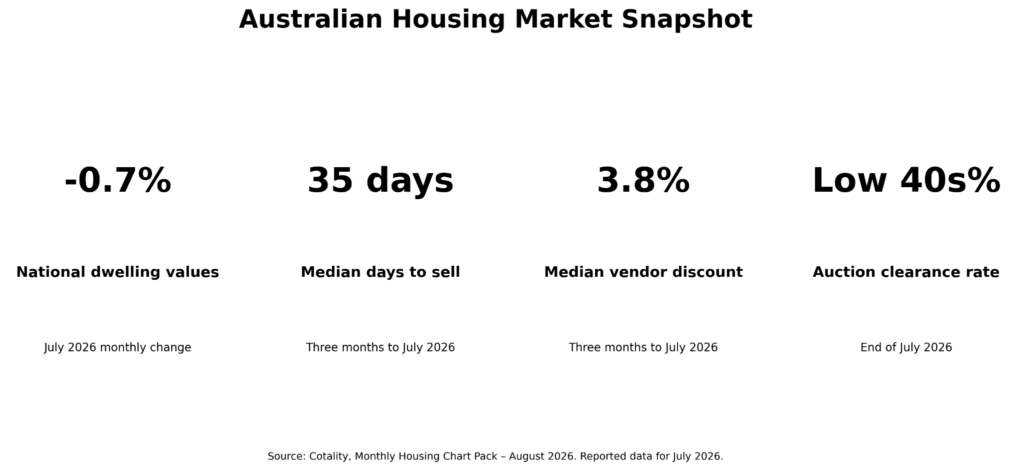
Cotality’s August 2026 Housing Chart Pack reported that national dwelling values fell 0.7% in July, while homes were taking a median 35 days to sell. The national median vendor discount also widened to 3.8%.
For buyers, that matters.
A market with longer selling times and greater vendor discounting can provide more opportunity to negotiate, particularly when a buyer understands the property’s fair value and the seller’s circumstances.
It does not mean every property is suddenly cheap.
It means buyers may have more room to be selective.
A market where knowledge can create an advantage
One of the biggest differences between property and other investments is the amount of information that can sit behind a single transaction.
A buyer who understands a suburb well may know:
- Which streets consistently attract stronger demand
- Which property types are easier to rent
- What comparable properties have actually sold for
- Which areas have strong owner occupier demand
- Where infrastructure is changing the local market
- What new developments could affect future supply
This local knowledge can change the way a buyer approaches a property.
Instead of asking, “Do I like this house?”
The better question becomes:
“Does this property make sense at this price, in this location, for my long term goals?”
That is a very different way of buying.

The opportunity and the risk are connected
An imperfect market can create opportunities.
But it can also create expensive mistakes.
The same lack of transparency that allows an experienced buyer to negotiate well can also allow an inexperienced buyer to overpay.
A property can look cheap because it needs significant work.
A high rental yield can look attractive while hiding weak long term demand.
A popular suburb can appear safe while the price already reflects years of expected growth.
This is why buying property is not simply about finding a bargain.
The goal is to find value.
And value is not always the lowest price.
What does value actually mean?
For a long term investor, value can come from several different factors.
It might be a property purchased below comparable market evidence.
It might be a location with strong population growth and limited housing supply.
It might be a property that can be improved over time.
Or it might be an asset with strong rental demand and the potential for long term capital growth.
The important thing is understanding what you are actually buying and why.

Why negotiation matters
Negotiation is another reason I believe property remains such an interesting investment.
The final purchase price is not always determined by a formula.
It is influenced by timing, competition, the seller’s circumstances, the property’s history and how well the buyer approaches the negotiation.
A good negotiation is not simply about making the lowest possible offer.
It is about understanding the market, knowing what the property is worth and knowing when to walk away.
That discipline can be just as valuable as finding the property in the first place.
Where a buyer’s agent can make a difference
This is where the role of a buyer’s agent becomes particularly relevant.
Buying well requires more than finding properties online.
A buyer’s agent can help with the research behind the decision, including suburb selection, comparable sales, property assessment and negotiation.
They can also help buyers stay focused on their strategy rather than becoming emotionally attached to one particular property.
For investors, that can be especially important.
The objective is not to win every negotiation.
The objective is to buy the right property at a price that makes sense.
A buyer’s agent’s value comes from helping bring together market knowledge, research, property assessment and negotiation into one buying strategy.

What I would focus on in the current market
With housing conditions becoming more varied across Australia, I believe buyers should be asking better questions rather than trying to predict exactly what the market will do next.
Look at:
Location: Is the area supported by long term demand?
Supply: How much new housing is likely to enter the market?
Demand: Who will want to live in the area in five or ten years?
Value: What are comparable properties actually selling for?
Rental market: Is tenant demand strong enough to support the investment?
Growth potential: What factors could support future capital growth?
Negotiation: Is there an opportunity to buy below the initial asking price?
These questions help turn property from a simple purchase into a strategic investment decision.
The long term is still what matters
Property is not a get rich quick investment.
There will be years when prices rise quickly and periods when the market slows or falls.
Cotality’s current data is a good reminder of this. National housing values have recently softened, but the longer term picture remains much more complex, with significant differences between individual cities and regions.
That is why I continue to believe in taking a long term approach.
The goal is not to predict every market movement.
It is to own quality assets in locations with strong fundamentals and allow time, rental income and potential capital growth to work together.
Final thoughts
Property remains my favourite investment because it rewards something that is becoming increasingly valuable in today’s market.
Good judgement.
You cannot control interest rates.
You cannot control government policy.
You cannot control the broader economy.
But you can control how much research you do, where you buy, what you pay and whether the property fits your long term strategy.
The property market may never be perfect.
And perhaps that is exactly why I continue to find it so interesting.
For a prepared buyer, imperfections can create opportunities.
CTA
If you’re considering your next property purchase and want to look beyond the headlines, an experienced buyer’s agent can help you assess the market, identify suitable opportunities and negotiate with your long term goals in mind.
